The Case for Going Very, Very Narrow
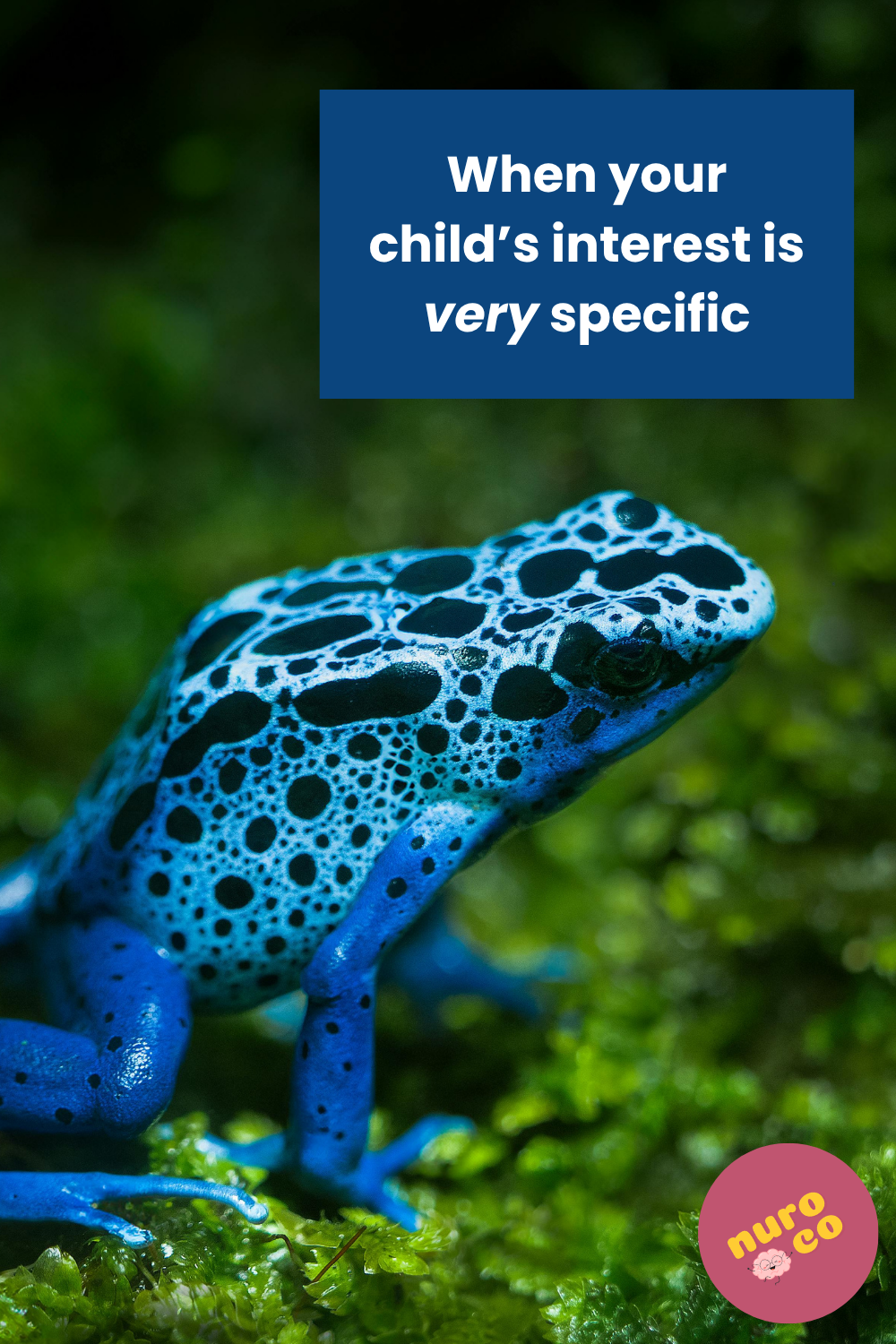
Your child becomes fascinated by a frog.
It’s easy to think: Great. We could do a whole project on amphibians. We could do lifecycles. Then habitats. Then maybe wetlands, food webs and ecosystems.
But what if your child isn't particularly interested in amphibians? What if they're interested in one frog? One very specific, weird frog that they want to know absolutely everything about.
Sometimes, when a child's interest is narrow, our instinct is to broaden it. But what if we didn't?
Bigger doesn't necessarily mean richer
Broad topics can give children plenty to explore.
Dinosaurs.
Space.
Ancient Rome.
The ocean.
But small topics can be just as interesting.
How astronauts go to the toilet.
Graffiti in Ancient Rome.
Greenland sharks.
Medieval cats.
Railway signals.
The magpies that visit the backyard every morning.
When you stay with a small subject, you can get past the obvious facts and start noticing the details.
A small window can reveal a much bigger world
Take Roman graffiti. On the surface, it can sound like a narrow topic.
But:
Who was writing on the walls?
Could most Romans read?
What did people joke about?
What did they complain about?
What were they selling?
What can something scribbled on a wall tell us about ordinary life two thousand years ago?
And how do we know any of this?
Why did some graffiti survive?
How do archaeologists date it?
How confident can historians be about what a particular message meant?
You’re still exploring Roman graffiti. You haven't needed to move on to "Ancient Rome" for learning to become broader. You’re just seeing more of the world through one small window.
Depth changes the questions
At the beginning of an interest, there's usually plenty to discover.
What is it?
Where is it found?
When did it happen?
How does it work?
But once those questions have been answered, you can explore things like:
Why do scientists think that?
How do they know?
Has anyone suggested a different explanation?
Why doesn't this example fit the usual pattern?
What haven't we figured out yet?
This is why going deep can become really interesting. You begin to encounter uncertainty. Different interpretations, exceptions, and information that doesn't fit neatly together. That's a different kind of learning from collecting enough introductory facts to declare a topic complete.
You don't have to turn it into a unit study
This is where homeschool enthusiasm can sometimes get the better of us.
A child develops a fascination with medieval cats.
Medieval cats!
That could lead to castles.
Knights.
Heraldry.
The Black Death.
Medieval food.
Suddenly, we have six weeks of medieval history planned and the cats have disappeared.
Maybe your child will happily come along for the ride.
But maybe the cats were the point.
There's nothing wrong with making connections or offering new possibilities. Interests often do branch out naturally. But we don't necessarily need to broaden them on the child's behalf.
If we stay with the cats, medieval life might creep in anyway.
Sometimes smaller is easier to get hold of
Let's learn about space.
Where do you start?
Planets? Stars? Rockets? Astronauts? Gravity? The Moon? The history of space exploration?
For some, the possibility is exciting. For others, it can feel overwhelming.
A specific question gives you somewhere to begin.
How do astronauts go to the toilet in space?
And that question might eventually lead to microgravity, engineering, water recycling, the International Space Station or the practical challenges of keeping humans alive away from Earth.
Or it might not.
Perhaps the learner finds out exactly how a space toilet works, feels thoroughly satisfied, and moves on.
You don't have to stay there forever
Going narrow doesn't mean deciding that this is now the topic for the next three months.
Interests move.
A fascination with Greenland sharks might eventually become an interest in deep-sea animals.
Railway signals might lead to transport networks.
Or none of those things might happen.
Sometimes a learner explores one tiny corner of a subject until they've had enough and then moves on to something completely unrelated.
We don't have to know where an interest will lead before we let them follow it.
How deep could this go?
The next time your child becomes fascinated by something specific, there may be no need to zoom out.
Instead of asking:
How can we make this interest bigger?
We could ask:
How deep could this go?