Level Up Learning: Gameschooling with Board Games
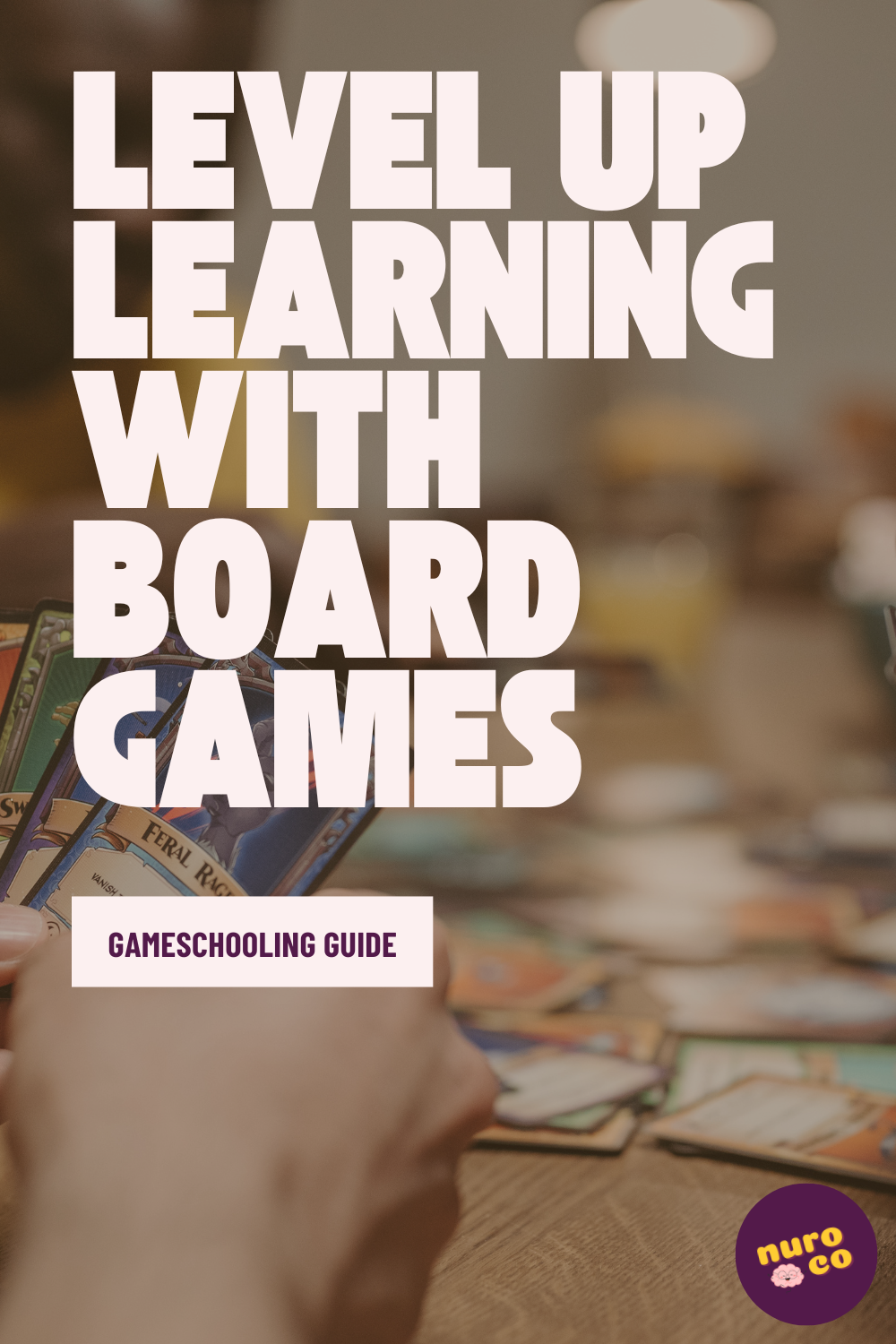
Homeschool doesn’t have to look like lessons and worksheets.
Sometimes, the most meaningful learning happens around the kitchen table - dice rolling, cards shuffling.
For many neurodivergent learners, board games offer what traditional lessons can’t: predictable structure, immediate feedback, and the joy of challenge without pressure. Games invite children to think strategically, problem-solve creatively, and connect with others - all while having genuine fun. That’s the heart of gameschooling.
Why board games work for neurodivergent learners
Board games have built-in supports that align beautifully with how many neurodivergent children learn best:
Clear rules and boundaries make expectations predictable and fair.
Turn-taking and teamwork build social skills in a structured, low-pressure way.
Immediate feedback helps sustain motivation and focus.
Visual and tactile elements create opportunities for sensory engagement.
Flexibility allows learners to join in at their own comfort level - whether that’s keeping score, managing cards, or helping to read instructions.
Because the focus is on play rather than performance, learners often discover new skills without even realising they’re practising them.
Game ideas to get you started
If you’re new to gameschooling, here are some tried-and-tested board games that blend fun with learning. Each one builds different kinds of thinking, strategy, and communication - and they’re all adaptable for mixed-age groups.
Strategy and Logic
Catan – Build settlements, gather resources, and trade with others to survive and thrive. Excellent for maths, planning, and negotiation.
Ticket to Ride – Collect train cards and claim routes across a map. Great for geography, number sense, and long-term planning.
Blokus – Fit colourful geometric shapes onto a shared grid, developing spatial reasoning and strategy.
Language and Storytelling
Codenames – Give one-word clues to help your team find the right words on the board. Builds inference, vocabulary, and teamwork.
Story Cubes – Roll a handful of picture dice and create a story connecting all the images - fantastic for imagination and sequencing.
Scrabble – Classic word creation and strategy game that strengthens spelling, vocabulary, and basic maths through point calculation.
Creativity and Visual Thinking
Dixit – Use illustrated cards and imagination to describe images without giving away too much.
Concept – Communicate ideas using only icons - brilliant for flexible thinking and nonverbal communication.
Mysterium – Work together to solve a mystery using dreamlike picture clues.
Teamwork and Social Skills
Pandemic – A cooperative game where players work together to stop disease outbreaks. Encourages teamwork, empathy, and big-picture thinking.
Forbidden Island – Race to recover treasures before the island sinks. Perfect for planning, adaptability, and collaboration.
The Mind – A quiet, intuitive game that challenges players to “think together” without speaking.
Logic and Problem-Solving
Robot Turtles – Introduces coding and algorithmic thinking through playful instructions.
Rush Hour – A solo puzzle game using logic to move vehicles and clear a path. Great for spatial reasoning and persistence.
Bringing games into your homeschool
You don’t need a “gameschool curriculum.” Start small and stay intentional:
Choose one or two games to rotate weekly.
Talk about the strategies that worked (and what you’d try differently next time).
Encourage your child to create a game review, design new cards, or design a scoreboard for documentation.
Many families find that once games become part of their week, learning feels lighter and more connected - the kind that sticks.
From player to designer
Once your learner starts changing rules or sketching their own boards, they’re already thinking like designers. Encourage them to:
Modify a favourite game (add new rules, re-theme it, or invent new cards).
Combine two existing games into something new.
Try designing their own from scratch with the Game Makers project - where play becomes creation.
Play is real learning
Gameschooling isn’t about replacing “real” learning - it’s about recognising that play is real learning. When your child is planning a move, explaining a rule, or imagining a new version of their favourite game, they’re building skills that go far beyond the board.
These moments of play are also moments of connection. They remind us that homeschooling doesn’t have to mean sitting apart with separate tasks - it can be shared, joyful, and full of discovery.
So next time you roll the dice or draw a card, notice the thinking, laughter, and teamwork that unfold.
Other posts in our gameschooling series